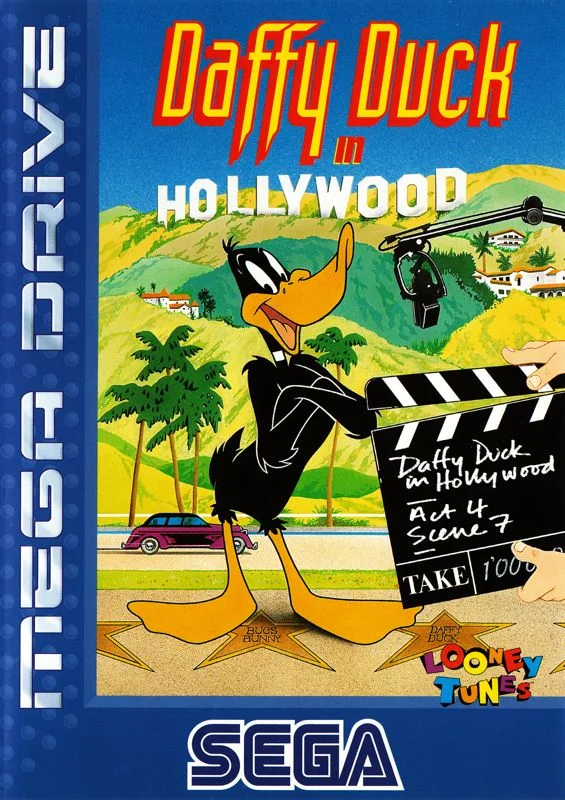
Daffy Duck In Hollywood
Platform game featuring sophisticated sprite compression on Sega Genesis
Words: David Broadhurst, programmer. 4 min read.
Fact file
- Year
- 1995
- Role
- Programmer
- Platforms
- Genesis, Megadrive
- Status
- Released
Watch on YouTubeCredits on MobyGames
This was my second game working with Probe, and while it looked like a straightforward platformer on the surface, the technology underneath made it special. Warner Bros. wanted a solid Looney Tunes game for the Sega Genesis, and we had some interesting technical challenges to solve.
The Compression Challenge
The tools programmer at Probe had developed a sprite compression algorithm that was genuinely clever. The raw sprite sheets were organized into 8x8 pixel tiles, and a mapping system was created so sprites could be assembled from these tiles. That part wasn't unusual - lots of games used tile-based graphics.
What made it interesting was the optimization. The system would shift sprites vertically and horizontally, and even apply 90-degree rotations, to find the optimal compression. This allowed duplicate tiles to be shared across different sprites, even when they weren't perfectly aligned. For its time, it was very sophisticated. Even now, I haven't seen many other systems that use this lossless approach.
Making Every Pixel Count
The compression system also had a pixel threshold feature - you could configure it to ignore tiles with less than a certain number of pixels. This helped optimize the truly sparse tiles without sacrificing the detailed ones. It was a practical solution to a real problem.
I spent a lot of time on the technical side implementing the sprite compression system. The payoff was worth it - the game could have significantly more detail and animation frames than a typical Genesis game would normally support.
The Result
Overall, I was pretty happy with how the game turned out. Given the complexity of the sprite system and the amount of animation on screen, keeping it running at a solid 50 frames per second (FPS) was satisfying. It was a technically interesting project, even if the gameplay itself was fairly standard platformer fare.
On video
Pictures
Genesis, Megadrive, 1995.
Genesis, Megadrive, 1995.